
Total Value Locked in DeFi Explained

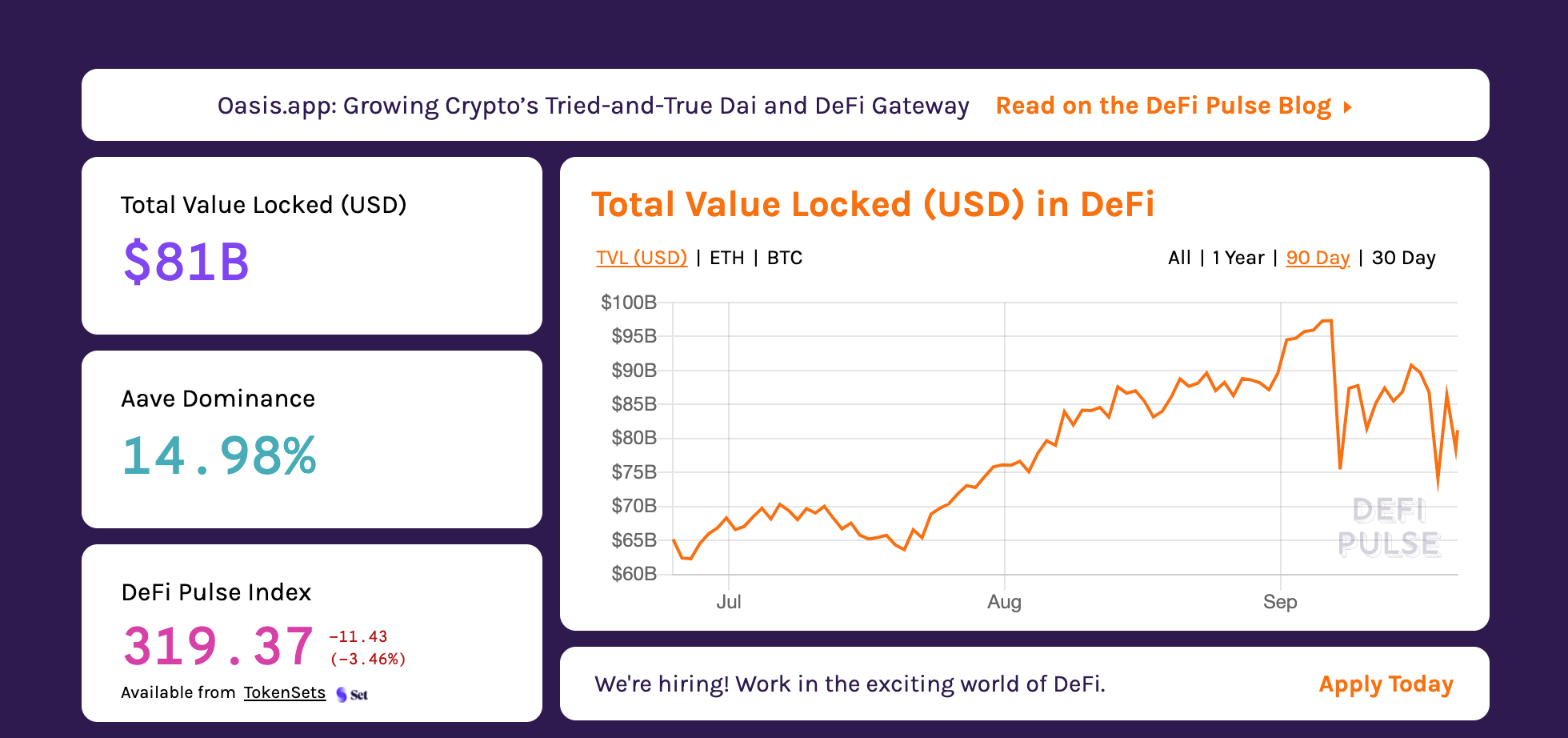
In simple terms, TVL shows how much crypto is locked in DeFi marketplaces. The metric is used to measure the overall ‘health’ of the DeFi and yielding markets.
Total value locked is a metric that is used to measure the overall health of the DeFi and yielding market. You can track total value locked on many services.
There are three main factors that are taken into consideration when calculating and looking at decentralized financial service's market cap TVL ratio: calculating the supply, the maximum supply as well as the current price.
In order to get the current market cap, you need to multiply the circulating supply by the current price. In order to get to the TVL ratio, you would need to take that market cap number and divide it by the TVL of the service.
The TVL metric is divided into 5 product categories that form the bulk of each DeFi application’s foundation. Each category may implement a slight variation on how TVL is calculated, from either “deposited” assets for lending protocols to “minted” assets for tokenization protocols.
Below, we will break down these 5 categories and provide simple examples of how TVL is calculated in each use case.
Lending
Lending is the most popular use case found in the Ethereum DeFi ecosystem. This process allows depositors to lend their valuable assets — such as ETH, WBTC, or LINK — to borrowers, who then collateralize the loans with their own locked assets.
In lending, the TVL metric is measured by the value of assets deposited into smart contracts by both the lenders and borrowers. Borrowers are then given a “credit line” containing up to 60% of their locked value.
MakerDAO is the leader in this category, presiding over $1.8B in locked assets that account for 2.39% of the total ETH in circulation and 14% of the total minted WBTC. Borrowers first deposit these assets in order to borrow the DAI stablecoin from the protocol.
Decentralized Exchanges
Decentralized exchanges have climbed the ranks quickly within the last year and have now become a staple when calculating TVL. DEXs, powered by liquidity pools, have amassed over $3.5B in deposited assets within their smart contracts.
In DEXs, TVL is measured by the value of assets deposited into the exchanges’ smart contracts, including order-book type exchanges like Loopring and DeversiFi. The liquidity pool exchanges like Uniswap, Curve, and Balancer are what truly break records when we measure TVL.
Uniswap is the leader in this category and the winner out of all DeFi protocols, holding over $2.35B in locked assets. Uniswaps liquidity for ETH, WBTC, and FYI is even deeper than that of centralized exchange giants like Binance and Huobi.
Derivatives
Derivatives have been a growing DeFi use case. Their products are tailored toward advanced traders who are already well served in centralized finance; additionally, the presence of Ethereum scaling roadblocks prevents better adoption. Derivatives allow asset deposits to power synthetic assets, futures contracts, and other options.
TVL in derivative protocols is measured by the value of assets deposited into the smart contracts, which provide the backing to synthetic assets and financial contracts. In options trading applications, users can deposit USDC to earn interest when traders buy the spreads in order to hold a position open.
Synthetix is the leader in the derivatives category, with over $592M in locked assets. Synthetix depositors “stake” (lock) the SNX tokens to create synthetic assets like USD, euros, gold, and Bitcoin. Synthetix traders can then earn fees from the platform when their minted assets are traded or redeemed back to SNX for a fee.
Payments
Payment protocols have yet to become a centerpiece of the DeFi ecosystem. Currently, payment protocols are Layer 2 solutions that allow users to exchange transactions at a faster rate for a cheaper price.
In payment protocols, TVL is measured by the value of assets deposited into smart contracts that are transferred to the payment protocol’s side-chain or plasma implementation.
Assets
Assets are tokenized “coins” — like Bitcoin and Stablecoins — that are newly minted in different applications’ smart contracts. These tokenized assets can then be used across the DeFi ecosystem for exchanges or collateral.
Stablecoins can be derived from “yield protocols” that allow depositors to receive an equal representation of their deposited tokens.
TVL in assets is measured by the number of coins that are tokenized. These tokenized assets represent a 1:1 redemption of the underlying asset.
WBTC is the leader in this category, currently possessing over $1B in Bitcoin that has been tokenized on Ethereum. These tokenized Bitcoins are now used across both the lending and DEX protocols, securing them an essential spot in the DeFi ecosystem.
Wrapping it up
While the TVL metric is an integral part of the crypto market, there are some that find the metric confusing, because each application may have a different view on what is considered to be in their custody.
If you enjoyed this simple breakdown, you can subscribe for more below.